The Unbreakable Ledger and New Economic Architecture
When the shadow of central authorities fades, the mathematics of trust takes over. The transfer of value is no longer entrusted to the promises of individuals, but to the encrypted certainty of the system.
For many years, the modern financial world was managed by a massive hierarchy established by central banks, intermediary institutions, and regulators. However, the emergence of digital assets has introduced an entirely new infrastructure that fundamentally alters this traditional structure. In this new order, trust is not manufactured by executives in tall buildings, but by a precise body of code sustained by thousands of computers working simultaneously. Eliminating the error margins, biased decisions, and sluggishness of traditional systems, this architecture brings transparent and absolute rules to the economy.
Blockchain Technology and Decentralization
For digital assets to exist, a recording system that cannot be copied or altered is strictly required. Copying a photograph or text on the internet takes seconds, but copying a financial value means the collapse of the system. The architecture that solves this digital duplication problem is the blockchain.
The Glass Accounting Ledger: Blockchain Architecture
We can think of the blockchain as a massive accounting ledger made entirely of glass, placed in the largest public square in the world. Anyone walking through the square can look deep into this ledger and clearly see which account sent how much money to whom. However, the greatest feature of this ledger is that no written line can ever be erased or altered later. Once a record is etched into the glass, it remains there for eternity.
In traditional banking, the accounting ledger resides solely in the bank's private vault and is updated behind closed doors. Conversely, in a decentralized blockchain network, an exact copy of this ledger is maintained simultaneously across thousands of different computers connected to the network. If someone attempts to fraudulently alter the ledger on their own computer, the thousands of other computers instantly detect the anomaly and reject that corrupted record.
Network Security and Node Validation Mechanisms
Validating the pages of this colossal glass ledger and adding new lines is not an ordinary task. Every computer connected to the network and holding a copy of this ledger is called a node. When a user sends a digital asset to someone else, this transaction is broadcast to all nodes. The nodes meticulously verify whether the sender actually holds that amount of funds in their account. If the vast majority of the network agrees on the accuracy of the transaction, it is irreversibly etched into the glass ledger. In this way, flawless security is achieved through pure mathematical consensus, without the need for any central boss.
Token Economy (Tokenomics) Rules
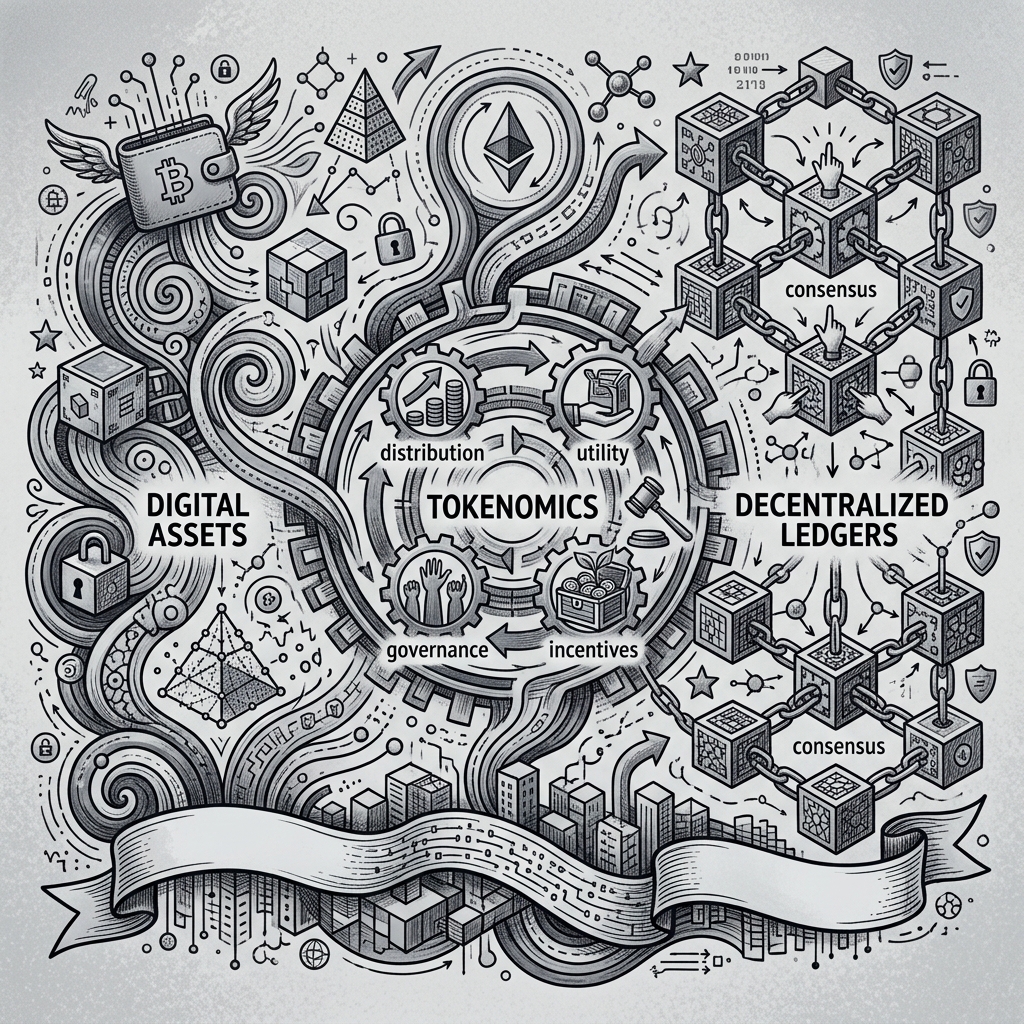
For the blockchain network to operate effectively, those thousands of computers must consume electricity and actively protect the system. So, why would these computer owners bear such significant costs? This is where the Token Economy (Tokenomics) comes into play. Tokenomics is the economic architecture that dictates the rules of the chips distributed as rewards to those who defend this glass ledger.
Token Creation and Reward Distribution
When the system administrators (miners or validators) securing the network successfully add a new page (block) to the ledger, the system automatically gifts them brand-new digital chips (tokens). This reward distribution is not based on the whims of a CEO, but is executed according to the unalterable codes written when the network was founded. Consequently, the network transforms into an organic, self-financing organism that grows without needing external venture capital. The more people join to provide security, the stronger the network becomes.
Inflationary and Deflationary Supply Dynamics
Every digital asset has a strict production and destruction policy embedded deep within its code. If a network continuously pumps a large amount of new tokens into the market (emission), this is an inflationary structure and, much like constantly printed fiat money, will erode the asset's value over time.
In contrast, some systems permanently destroy (burn rate) the tokens they collect as transaction fees or lock the total supply from the very beginning. If more tokens are thrown into the fire and destroyed (burn) than the production rate (emission), the asset becomes increasingly scarce. This represents a deflationary structure. The tokenomics model carefully balances this supply and demand, ultimately shaping the long-term price destiny of the project.
Digital Asset Classes and Market Value
Not every chip or asset produced in the digital realm serves the same purpose. Just as stocks, bonds, and cash possess different functions in the traditional world, digital assets also have strictly defined roles separated by clear boundaries.
Cryptocurrencies and Payment Networks
Certain digital assets are created explicitly to provide a global, censorship-resistant transfer of value. These are next-generation cash systems that do not recognize national borders or weekend holidays, capable of carrying value to the other side of the world in mere seconds. Their primary objective is to accelerate trade and act as a secure digital vault protected against inflation.
Utility and Governance Tokens
On the other hand, some digital assets function as fuel or voting ballots within a specific application. Utility tokens are the digital tickets a user must pay to execute a special operation (such as storing a digital file) within that ecosystem. Governance tokens, however, grant the right to vote on the future decisions of that project. Just as shares translate into votes at a company's general assembly, these tokens offer a digital referendum right for potential changes in the project's underlying code.