
Smart Capital Exiting the Peak
When markets overflow with euphoria, when every amateur on social media feels like a financial wizard, and when news outlets promise permanent expansion, defending your capital becomes exceptionally difficult. The hysteria of the crowd is highly infectious; it whispers that you must buy more at the absolute peak. Yet, at this precise moment of dazzling optimism, the actual architects of the market are quietly walking toward the exit. Smart money does not crash through the front door; it distributes its massive positions piece by piece to emotional, late-stage retail buyers.
To survive as a retail investor, you must look past the superficial illusions of the peak and decode the algorithmic warning signs of distribution. A rising price index does not imply structural stability. You must see exactly who is paying for the smart money's exit ticket.
Churning: The Signature of Institutional Departure
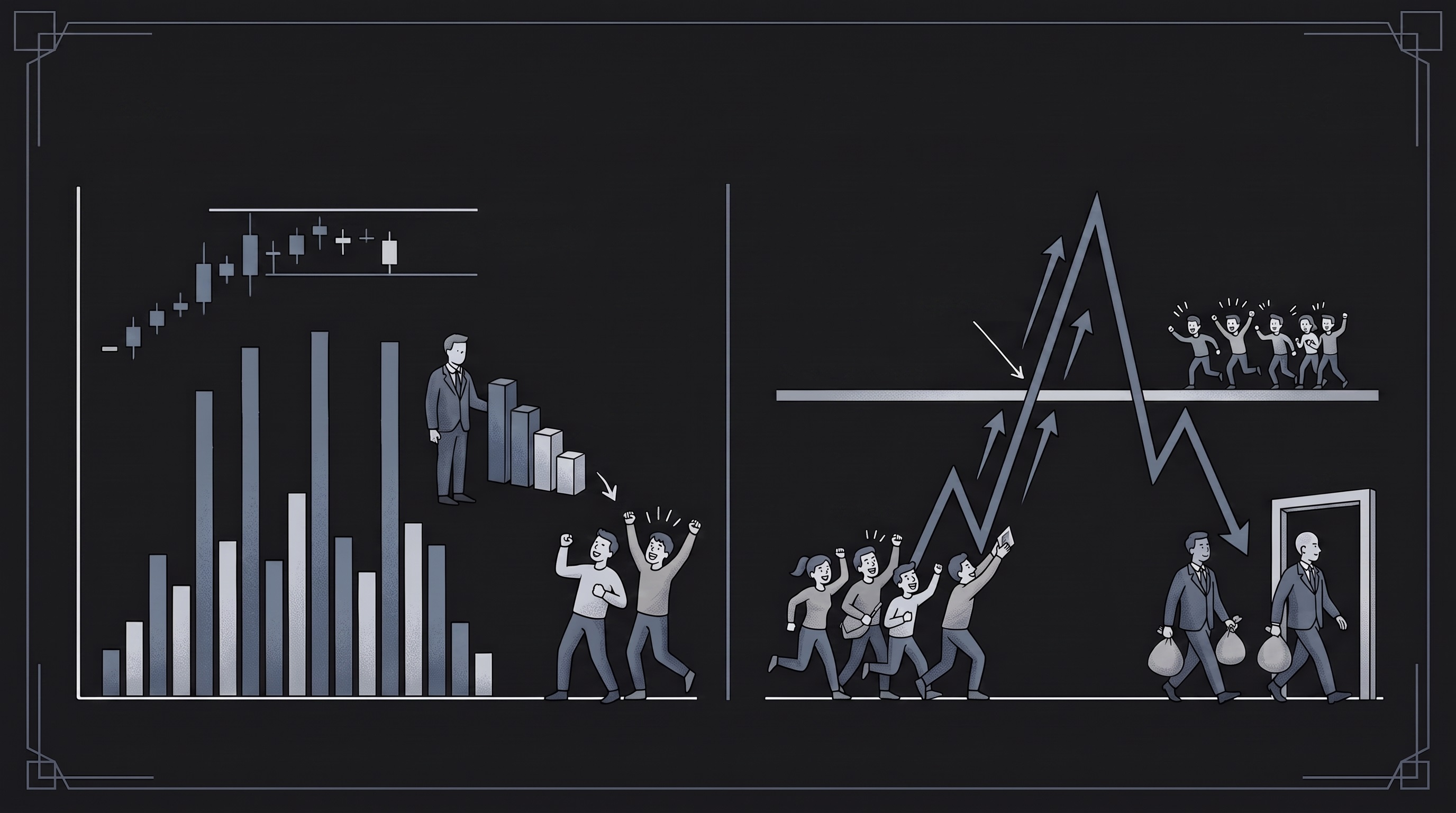
The most definitive structural anomaly at a market top is a dramatic expansion in trading volume that completely fails to push the price higher. In market mechanics, this phenomenon is identified as "churning."
- The Effort vs. Result Discrepancy: Under healthy conditions, massive buying volume (high effort) should naturally propel the asset price aggressively upward. However, during the distribution phase, despite vertical spikes in the daily volume bars, the price closes flat or secures only razor-thin gains.
- The Invisible Ceiling of Supply: The mathematical reality underlying this behavior is that institutional players are systematically matching every emotional retail buy order with their own massive sell blocks. The upward momentum is entirely absorbed by structural supply. The engine is roaring at maximum RPM, but the wheels are spinning in place. This is where smart money unloads inventory without triggering a panic.
The Upthrust: Trapping the Final Buyers
Large players cannot liquidate millions of shares in a single transaction without causing a flash crash. To prevent this, they must continuously sustain retail buying appetite. Their primary tool for this is the fake breakout (Upthrust).
- The Breakout Illusion: The price is suddenly and aggressively propelled above a long-standing resistance barrier. Traditional retail indicators immediately flag this as a definitive "buy signal." Driven by the fear of missing out (FOMO), late-stage retail capital rushes to buy the breakout.
- Locking the Exit: Once the massive pool of retail buy orders above the resistance is fully matched with institutional sell orders, the price is slammed back down below the barrier. The trap is sprung. Smart money has transitioned entirely to cash, leaving the emotional crowd holding overvalued inventory at the absolute peak of the cycle.
True financial sovereignty does not come from participating in crowd euphoria; it comes from identifying exactly who is funding the exit of smart capital. Track the algorithmic warning signs of distribution. At the peak, extreme volume is never a sign of strength—it is the heavy friction of a structural collapse waiting to happen.