
What is a Stock, Really?
The financial world loves to drown you in complex terminology. Between charts, moving averages, and jargon-heavy analysis, it is easy to lose sight of the foundational truth. Beyond the technical definitions, what does a stock actually mean for you?
The answer is neither market speculation nor a digital gambling code. In its purest form, a stock is sovereignty and partnership.
Why the System Exists: The Engineering of Function
When you buy shares of a company, you are not just tracking a piece of a chart moving up and down. You physically own a small fraction of a system, a production mechanism, or an idea.
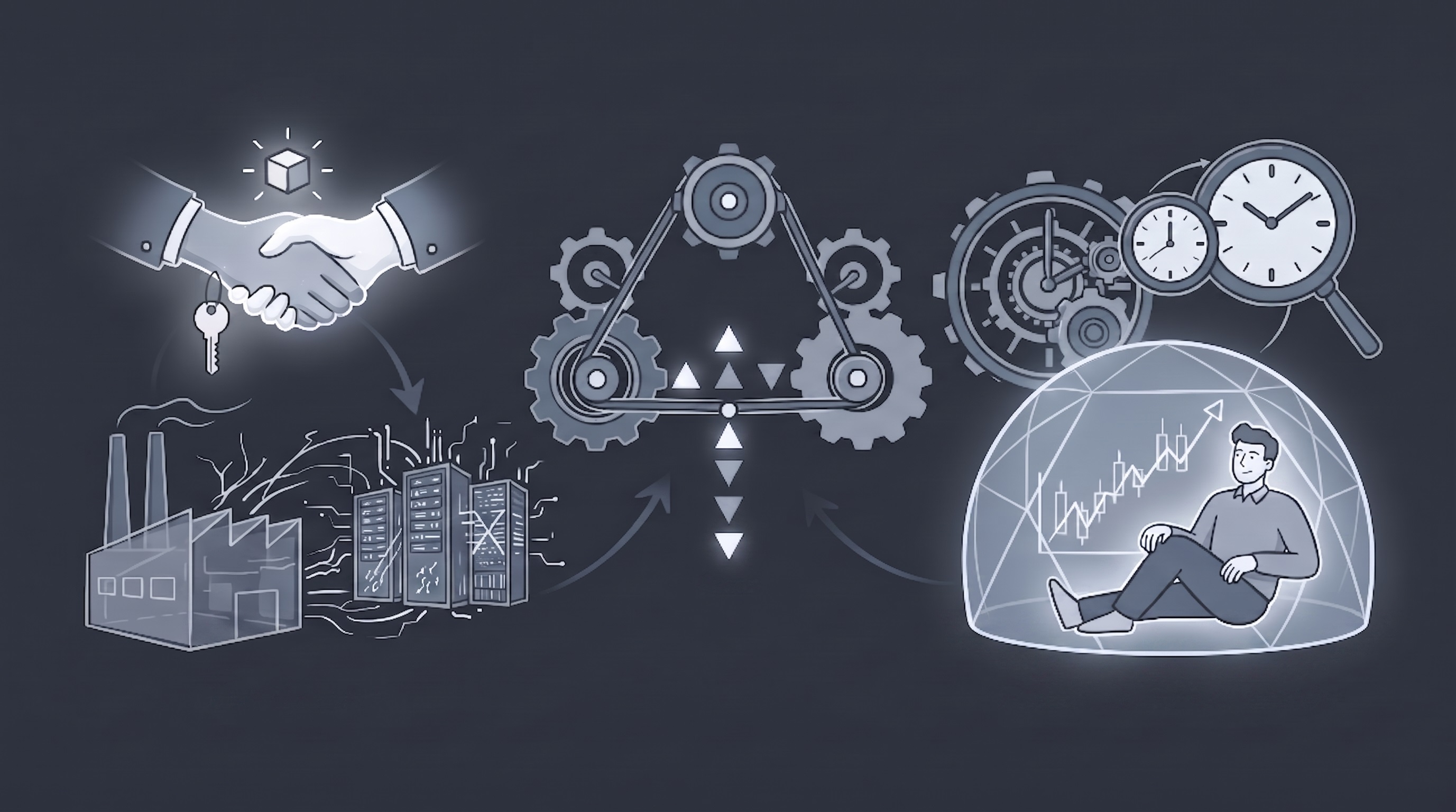
Capital markets are massive matching engines built to finance complex societal needs. On one side, there are entities with world-changing ideas but no capital; on the other, individuals seeking to protect and grow the value of their labor. The stock exchange is simply an algorithm designed to bring these two independent forces together frictionlessly.
How Buyers and Sellers Match: Beyond the Hype
The mathematics behind the market is transparent, yet it becomes invisible due to the surrounding noise. In the exact millisecond you buy a stock, an algorithm or a human somewhere else in the world has decided to sell it. Public exchanges instantaneously melt billions of different expectations and mathematical models into a single common denominator: Price.
This matching process is not a game of chance; it is collective intelligence searching for an objective equilibrium in real-time. As information velocity increases, this engine optimizes to run with higher stability and less error.
Why You Should Own a Piece: Financial Sovereignty
Time is the most limited resource modern humans possess. The value you generate by spending hours working every day can easily erode against inflation and structural inefficiencies.
Owning a stock is the mathematical way to multiply your own time by leveraging the optimized business models of others. You become a partner in the efficiency generated day and night by a technology giant or a manufacturing plant. You stamp your own signature onto the gears of systems that work, produce, and create value while you sleep. Financial sovereignty means running the mechanics of the system in your favor, rather than being crushed under its weight.
- Data-driven stability eliminates speculative noise.
- True partnership relies on a deeper mathematical logic than mere price movements.
- Every individual equipped with the right tools can decode the logic of this global machine.