
The Horizon of Sovereignty: Why We Sustain
We often treat improvement as a mission to be completed—a mountain to be climbed and then abandoned. We apply ourselves to sorting, setting in order, shining, and standardizing, and we feel a momentary surge of clarity. Then, inevitably, the drift begins. Life is not a static environment; it is a constant force of entropy, always pulling back toward the comfort of the cluttered and the chaotic.
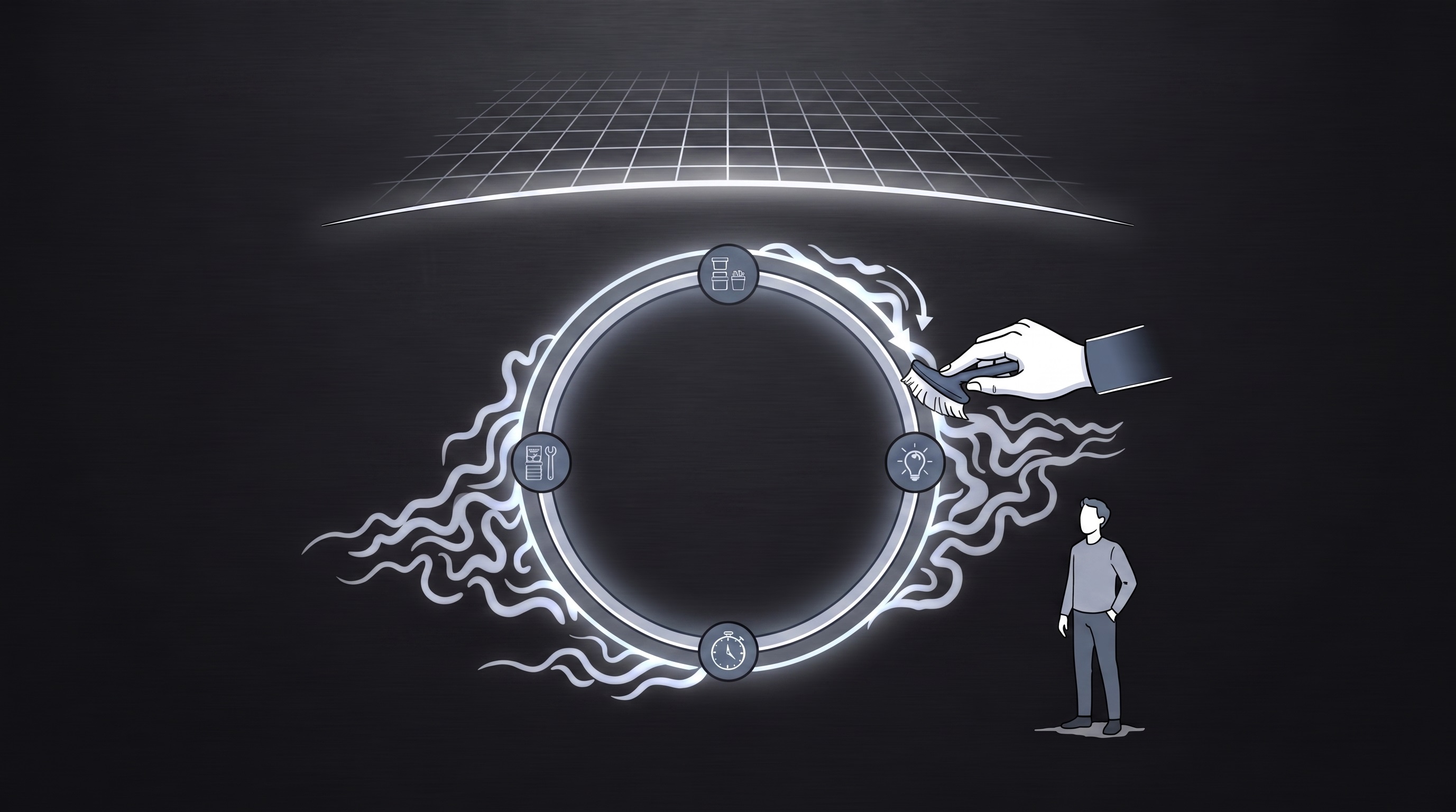
The Delusion of Finality
The most dangerous idea in the pursuit of efficiency is the belief that you can ever "finish." Sustaining is the admission that the work of sovereignty is a cycle, not a destination. It is the practice of vigilantly watching for the return of friction before it has the power to obstruct your progress.
- The Commitment to Baseline: Sustain is the promise that the progress you have fought for today will be the minimum standard for tomorrow.
- Resilience Against Drift: When you sustain, you are building the capacity to recognize the subtle, incremental decline before it manifests as total disorder.
- The Integrity of the Self: You sustain not because a system demands it, but because you deserve an environment that continuously reflects your highest intent.
The Rhythm of Stewardship
Sustainment is not about rigid enforcement; it is about the quiet stewardship of your own freedom. It is the realization that your focus is a finite resource, and every moment spent fighting the chaos of an unmaintained environment is a moment stolen from your future.
Sovereignty as a Continuous State
When you embrace the discipline of sustainment, you move beyond the role of a task-manager and into the role of a system-architect. You are no longer just fixing your world; you are ensuring that it remains a tool that empowers your growth.
True sovereignty is found in the ability to maintain your own clarity despite the noise of the world. It is the quiet, daily decision to protect your focus, your time, and your potential. Because a life engineered for infinite scalability should never be dragged down by the weight of the past.